The Revolution Has No Manual
AI isn't taking our jobs. The post-pandemic economy is correcting itself, and AI is getting the credit. The fear is aimed at the wrong target.
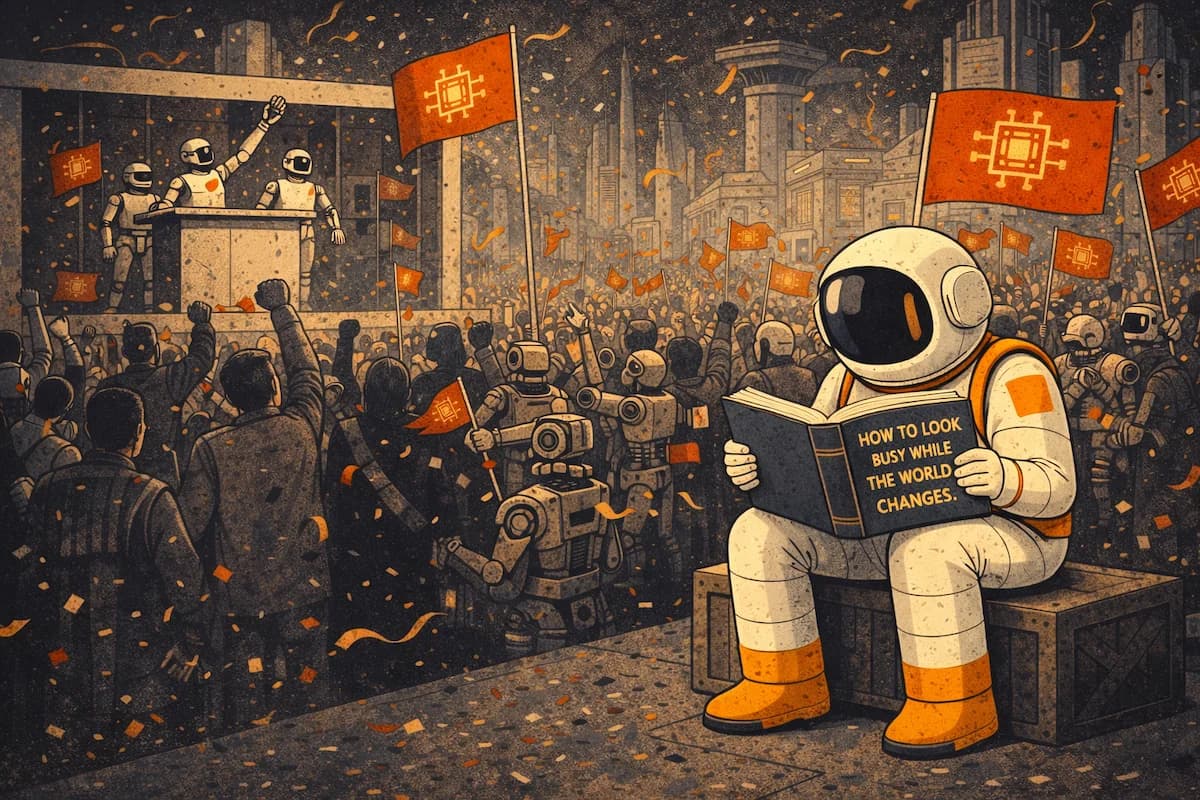
Every revolution promises a new world.
What they don't mention — the old one hasn't finished collapsing yet.
We're in the middle of one right now. The language is everywhere — disruption, paradigm shift, a new era. Half the room is thrilled. The other half is updating their CV. Some are doing both.
The revolution is here. The instructions aren't. If you feel like you're the only one improvising, look around.
Capital Has Never Done Its Own Dishes
There's a belief floating around that AI will finally let business owners do everything themselves. No employees, no overhead, no messy human problems. Just a founder and a fleet of agents.
It's a seductive idea. It's also not new.
When the first irrigation systems appeared in Mesopotamia, the landowner didn't dig the channels himself. He found someone to dig them. When the printing press arrived, the publisher didn't set the type himself. He hired a typesetter — a job that hadn't existed the day before.
The pattern has been running for thousands of years. New technology arrives. The powerful get excited — "now I can do it all myself." They try. They realize they can't. Not because the technology doesn't work, but because doing the work was never just the work. It was the planning, the fixing, the adapting, the explaining, the scaling, the part where nothing goes as expected and someone has to figure out why.
The Industrial Revolution didn't turn factory owners into machine operators. It created machine operators. The assembly line didn't eliminate workers — it redefined what a worker does. The computer didn't empty the office. It filled it with people who do things that "office worker" didn't used to mean.
Every time, the same cycle: old role dies, new role is born, and the person with capital still needs the person with skill. The skill just looks different than it did yesterday.
AI is the latest chapter, not a different book. The CEO who says "I replaced my entire team with AI" is in the same position as the factory owner in 1820 who said he didn't need craftsmen anymore. He was right — he didn't need those craftsmen. He needed different ones. And he needed them more than he expected.
The Sprint Was Impressive. The Marathon Wasn't.
Of course, there's been an attempt to solve this from the other direction.
What if you removed the capital owner entirely? No bosses, no profit motive, no hierarchy. Let the workers own the means of production. Let the system distribute equally.
It's not a hypothetical. It ran for the better part of a century, across multiple countries, with millions of people.
And it wasn't all failure. It industrialized entire nations in a generation. It sent the first human being into space. It achieved near-universal literacy in countries that had been largely agrarian decades before. When the system pointed all its energy at a single goal, it could move mountains — sometimes literally.
But it couldn't keep them moving. The sprint was impressive. The marathon was the problem.
When nobody has skin in the game — when there's no one who loses sleep over whether the thing ships, whether the customer is happy, whether the architecture holds under load — production doesn't just slow down. It drifts. Toward "good enough for the report" instead of "good enough for the user." The system didn't collapse because people stopped working. It collapsed because the feedback loop between effort and outcome broke.
Ownership isn't about who signs the paycheck. It's about who stays up at night thinking about what's broken. Remove that, and the machines still run — they just stop running toward anything that matters.
So here's where we actually are: the owner can't do it alone, and the system can't run without someone who cares enough to steer it. Neither side of that equation has ever been optional. Every technology that promised to change this — the steam engine, electricity, the internet — ended up proving it instead.
Now we have agents that can build, write, analyze, and ship faster than any human team. But they don't decide what's worth building. Direction isn't a task you can delegate — it's the thing that makes every other task worth doing.
AI won't be the exception.
The Morning After the Party
Now let's talk about what's actually happening — because the headlines are telling the wrong story.
Between 2020 and 2022, tech companies hired like the growth curve would never flatten. Remote work exploded. Venture capital was cheap. Every startup was "scaling aggressively" and every corporation was "investing in digital transformation." Engineers were getting multiple offers in a week. Salaries doubled. Signing bonuses appeared out of nowhere.
It was a party. And like every party, nobody was thinking about the morning after.
The morning after arrived around 2023. Interest rates climbed. Growth slowed. The numbers stopped making sense. And suddenly, companies that had hired thousands needed to explain why they were letting thousands go.
"We're restructuring to invest in AI." "We're realigning our workforce for the AI era." "We're building a leaner, AI-first organization."
Read between the lines. Every single time, the subtext is the same: we hired too many people when money was cheap, and now we need a narrative that doesn't make us look reckless. AI is the perfect cover — it sounds strategic instead of embarrassing.
This doesn't mean AI has no impact on jobs. It does. But the wave of layoffs you're seeing right now? Most of it is a correction, not a replacement. The companies cutting teams aren't doing it because an AI agent replaced those people overnight. They're doing it because the economics stopped working two years ago, and they finally ran out of runway to pretend otherwise.
The dangerous part isn't the layoffs themselves. It's that we're misattributing the cause. When you blame AI for something the economy did, you create a fear that's impossible to fight — because you're fighting the wrong enemy.
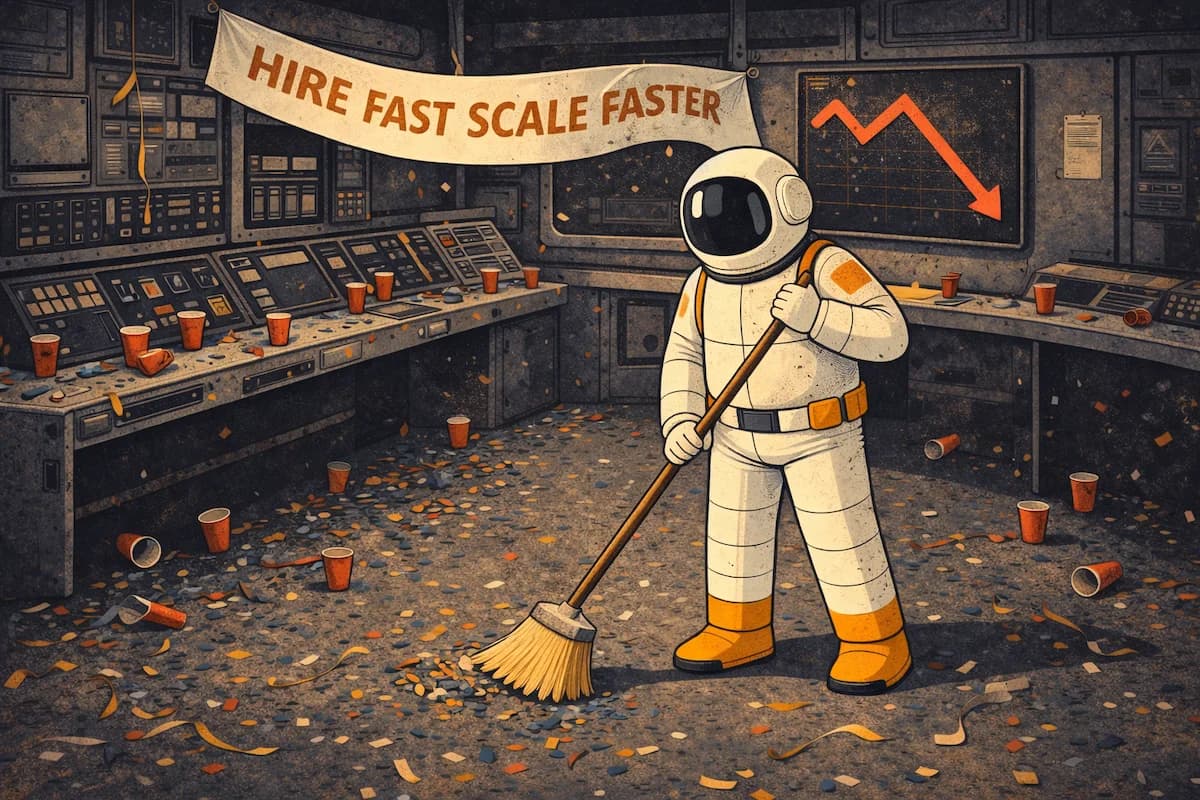
The Job Description Died. The Job Didn't.
So if AI isn't the mass job killer the headlines suggest — what is it actually doing?
It's rewriting the job description. Not eliminating the job. There's a difference, and it matters.
Two years ago, "prompt engineer" was the hot new title. Already, it sounds almost quaint. It evolved into something called context engineering — designing the entire information environment an AI operates in. The job didn't die. It grew up. At some companies, "software engineer" is quietly being replaced by "builder" — not because the engineering went away, but because the walls between roles did. Engineers think like product managers now. Product managers ship code. Designers build functional prototypes before lunch. The old assembly line — one person writes the spec, another designs it, another builds it — is dissolving into something messier and more fluid.
Consider what's happening with vibe coding. People who never wrote a line of code in their lives are shipping products. Marketing teams are automating workflows they used to beg engineering to prioritize.
The knee-jerk reaction is: "See? They don't need developers anymore." But look at what actually happens next. The prototype works. The founder gets excited. Users show up. And then — the thing needs to scale. It needs security. It needs to handle edge cases that no AI anticipated. It needs someone who understands why the database is on fire at 3 AM.
The developer didn't become obsolete. The entry point just moved. More people can start the journey now — but the destination still requires skill, experience, and the kind of judgment you can't prompt your way into. Same story in support — companies that replaced their team with chatbots are now hiring people to fix what the chatbot gets wrong.
The hiring criteria shifted, yes. "Do you know React?" matters less than it did. "Can you work alongside AI, evaluate its output, and know when it's confidently wrong?" — that's the new question. And it's not an easier question. It's a harder one.
Here's the thing most people get wrong about this: they assume that doing the same work faster means needing fewer people. It's intuitive. It's also historically backwards. When spreadsheets replaced ledger books, the number of people working with numbers didn't shrink — it exploded. Suddenly you could ask questions that were previously too expensive to touch. When smartphones made software distribution nearly free, we didn't end up with fewer software companies — we ended up with an entire economy that didn't exist before.
Efficiency doesn't just reduce cost — it unlocks demand.
When the cost of building something drops, the number of things worth building goes up. A developer who used to spend three days on a feature now ships it in an afternoon. That doesn't mean the company fires four developers and keeps one. It means the roadmap that was "maybe someday" becomes "next sprint."
The one-person startup that ships an MVP in a weekend isn't the end of the story. It's the beginning. Because the moment that product finds users, a familiar gravity kicks in: support tickets, localization, partnerships, compliance, sales, hiring. The tools got better. The needs didn't get simpler.
What actually changes isn't how many people work. It's what they work on. The tasks shift. The tools shift. The job titles shift. But the underlying demand for human judgment, human creativity, and human accountability — that part is remarkably stubborn.
The Ruins Have Tenants
I'm not going to pretend this is painless.
Some jobs will disappear. Not transform, not evolve — disappear. The transition will be uneven and unfair. The people most affected won't be the ones reading think pieces about the future of work. They'll be the ones who were never given the chance to prepare.
That's real. And no amount of "new jobs will be created" rhetoric makes the gap between losing the old one and finding the new one any less brutal. The economy doesn't wait for you to reskill. Rent is due now.
But here's where it gets interesting — and where history offers something that isn't just cold comfort.
Things we declared dead have a strange habit of coming back. Vinyl records were finished. Then they became the fastest-growing segment in the music industry. Independent bookstores were over. Then people got tired of algorithms choosing their reading list. Handmade goods were inefficient relics. Then "handcrafted" became a premium label that commands twice the price.
There's a pattern here, and it's not nostalgia. It's a market correction. When machines can produce everything, the thing that becomes scarce — and therefore valuable — is the thing the machine didn't touch. Human judgment. Human taste. The imperfect, opinionated, deliberately chosen thing.
We're already seeing the early signals in software. "Built by a human team" is starting to appear in product marketing. Not because AI-built products are bad — but because customers are beginning to ask who's behind what they're using. That question didn't matter five years ago. It matters now. And it'll matter more.
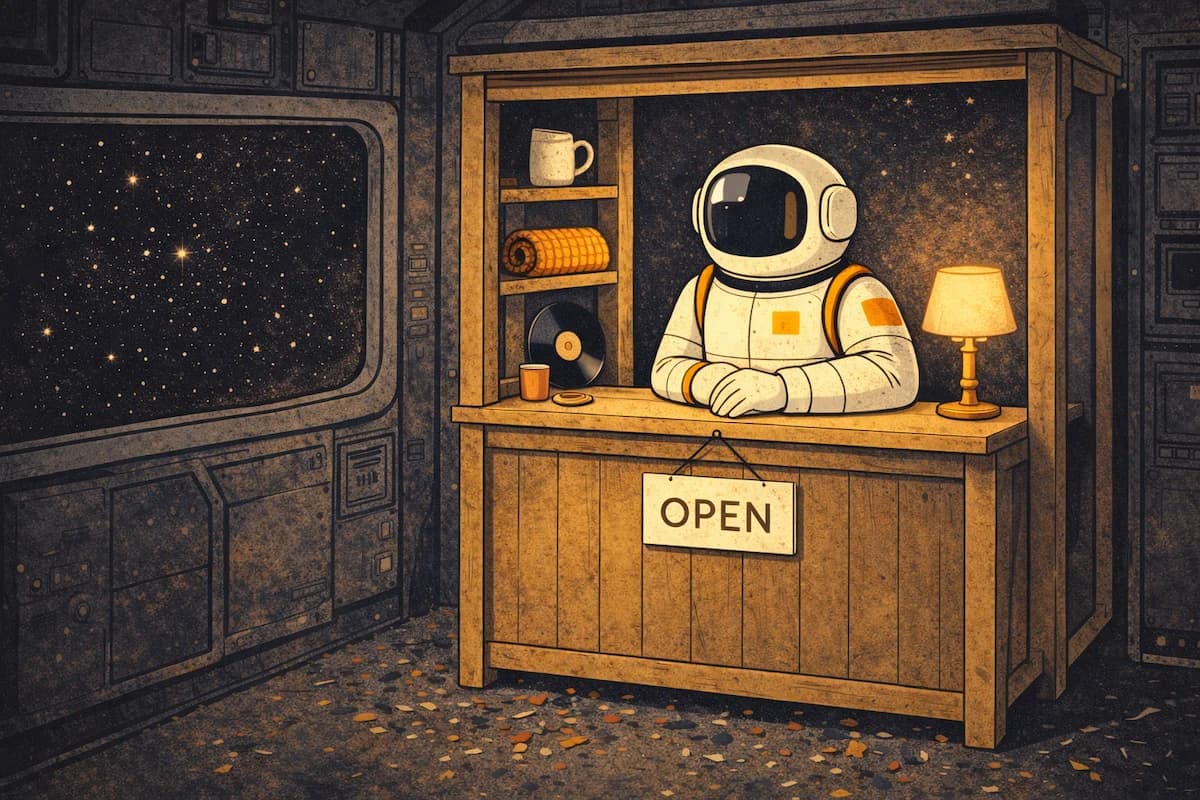
The jobs that vanish in the first wave won't all stay vanished. Some will return wearing different clothes, carrying a higher price tag, valued precisely because a person chose to do them when a machine could have.
This doesn't mean everyone wins. It doesn't mean the transition is fair. It means the question isn't "will I have a job?" — it's "will I recognize my job?" And honestly? Maybe not right away. But that's been true of every generation that lived through a revolution. The ones before us didn't have a map either.
So no — communism isn't coming. The machines won't own themselves, and the people who own the machines will still need people to make them useful. That equation is older than electricity.
Universal basic income might happen someday, but not because everyone is unemployed. If it happens, it'll be because we decided that a floor of dignity is worth building — which is a political choice, not a technological inevitability.
The AI revolution is real. The fear is real. The disruption is real. But the story being told — that this is the one technology that finally replaces all of us — is the same story that's been told about every technology before it. And every time, the storytellers underestimate the same thing: the sheer, stubborn, irrational creativity of people who need to make a living.
We will adapt. Not because we're fearless — because we don't have a choice. The ground shifts, we look around, we find the new solid ground. That's not optimism. That's just what the record shows, every single time.
Some of us are already walking. Most are still looking around. That's fine. The instructions never come first. They come after someone figures it out and writes them down for everyone else.
We don't need to know where this is going. We just need to stay curious enough to not stop moving.