The Ant Colony
Every standup was short. Every deadline made sense. Nothing was ever blocked. We took that for a sign things were going well.

An ant colony begins as one queen, one hole, no trails yet: all one thing.
We were that, once. Then we were sixty people, two floors, two of everything.
The meeting room
The meeting room had eight people in it and eight different products being built.
The QA wanted the bug list to shrink before Friday. The business analyst wanted the requirements signed off so the document could be closed. The designer wanted the new component library to land in this sprint, not the next one. The developer in the corner wanted to refactor the auth layer while we were already in there. The other developer wanted the ticket closed and lunch. The project manager wanted the burndown chart to look like a burndown chart. The product owner wanted the client to approve the demo on Thursday. Someone, somewhere, wanted the budget to hold.
It was, in its way, a beautiful thing. Eight people, eight clear priorities, no two the same, all of them being pursued in parallel, in good faith, on full salary, in the same forty-minute slot. Nobody was waiting on anyone. Nothing was blocked. The standup the next morning would be short.
We left the meeting and went back to our desks and worked very hard, all of us, on completely different things.
Downstairs
Downstairs, our world was full. Customer complaints came in every morning and we triaged them. Two teams weren't talking to each other and we mediated. The deployment process took forty minutes and we shaved it down to twelve. The new hire couldn't get her laptop set up and we sat with her for an afternoon. A junior dev was burning out and we noticed and we did something about it. The on-call rotation needed rewriting because it wasn't fair to the people in different time zones. Someone had to write the postmortem for last week's incident, and someone had to read it, and someone had to make sure we didn't do it again.
These were real problems. They consumed real hours. They were the texture of every working day.
Upstairs
Upstairs, their world was also full. The pipeline needed three more deals before the end of the quarter. A potential client in Germany had gone quiet and needed a nudge. The pricing model had to be revised because the last two proposals lost on cost. A conference was coming up and someone had to prepare the keynote. Investors wanted an update. The board deck wasn't going to write itself. A competitor had just launched something and we needed a position on it by Tuesday.
These were also real problems. They also consumed real hours. They were the texture of every working day, upstairs.
Neither side was lazy. Neither side was wrong. Neither side had any idea what the other side was actually doing all day.
Walking past each other
When we asked upstairs for help — we need more time on this release, the quality is slipping, we're losing engineers to burnout — the answer was kind but distant. They listened. They nodded. They said they understood. And then nothing happened, because it wasn't that they didn't care. It was that our problem wasn't on their list, and you can't act on something that isn't on your list. There are only so many hours.
When upstairs asked us for help — we need a demo for Thursday, can you put together a case study, the client wants a technical deep-dive — we did the same thing. We listened. We nodded. We said we understood. And then we went back to fixing the deployment pipeline, because their problem wasn't on our list either.
The strange thing wasn't the conflict. There was no conflict. We liked each other. We respected each other. We had drinks together. We were all working, hard and in good faith, in the same forty-hour week. The strange thing was where it was all pointed — two groups of people in the same company, facing opposite ends of the same hallway, and somehow not noticing.
The fog
When the team was small, none of this happened. There were six of us and one founder and we all knew what we were building and why. The founder walked past your desk every day. You overheard the sales calls. You saw the customer emails. You knew which deal was about to close and which engineer was about to quit. The goals weren't written down anywhere because they didn't need to be. They were in the room.
We were six people doing six different things, too — one on the API, one on the deck, one on whatever the founder needed by Thursday — and it all added up to one product.
In a small ant colony, the queen is right there. Every ant has felt her, recently. The pheromone trail is short and strong and there's only one of it. You don't need a map; you can smell the way home.
Then the colony grows. The queen is still there, somewhere, but most ants have never seen her. The trails multiply. Some trails are old. Some trails contradict each other. Some ants are following a trail laid down by an ant who was following a trail laid down by an ant who was following something that used to be a trail but isn't anymore. Everyone is walking with purpose. Nobody is walking in the same direction.
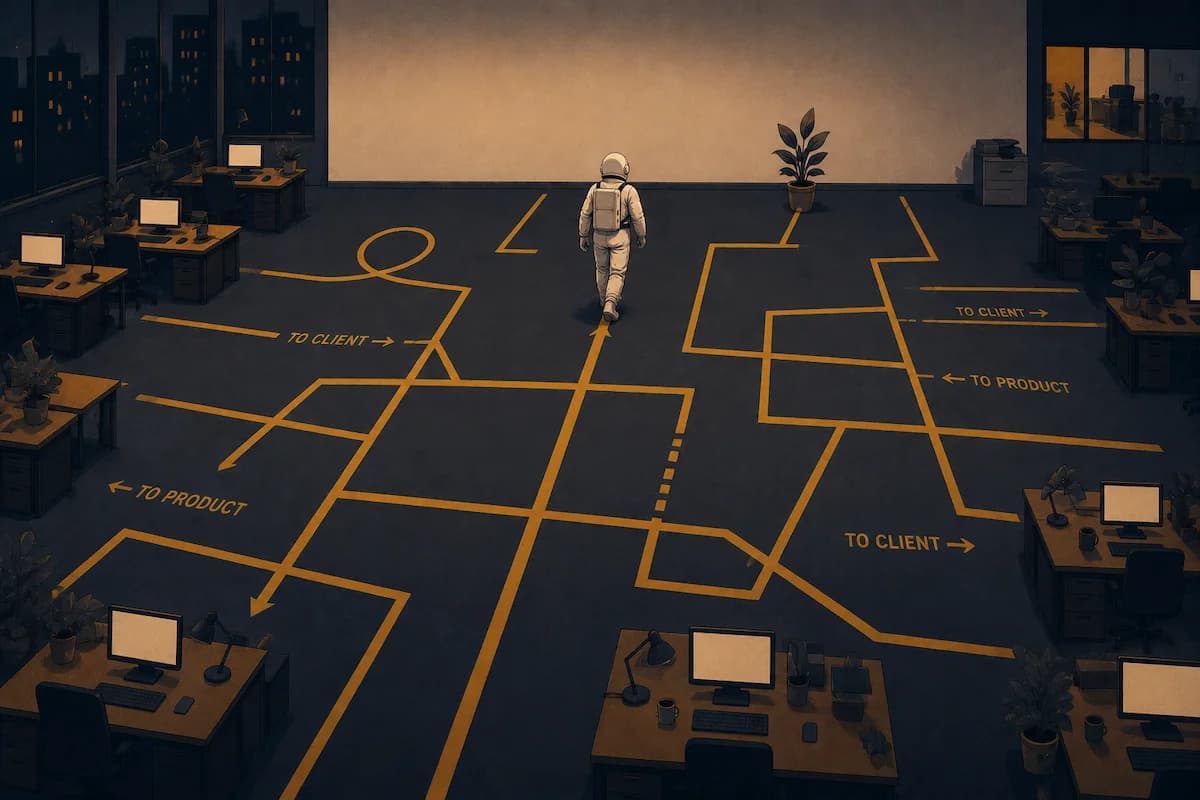
This is where it broke for us. Not at twenty people, not at fifty, but somewhere in between, in a fog we didn't notice we were walking into. One quarter we were a team. The next quarter we were several teams in a trench coat, and the trench coat was the company logo.
The work got worse. Not dramatically, not visibly, just — worse. A little less care here. A little more haste there. A bug that would have been caught last year, shipped this year. A client who would have been delighted in 2022, mildly satisfied in 2024. Nobody could point to the thing that had changed, because nothing had changed. Everyone was still working hard. Everyone was still good at their job.
The thing that had changed was that nobody was working on the same thing anymore. Somewhere in the growing, somebody had decided that was the plan.
Keeping the trail alive
There's a version of this essay that ends with a framework. Set clear goals. Cascade them down. Align incentives. OKRs, KPIs, North Star metrics — there are libraries of books on this, and most of them are right. But the books aren't really the point. The books are tools, and tools only matter if you know what you're trying to build.
Setting the direction is a leadership job. That part isn't shared. Someone has to decide what the company is for this quarter, this year, this market — and that someone sits near the top, by structure if not by title. There's no version of this where the colony figures it out by committee.
What is shared is what comes after. Once the direction exists, it has to travel — into the sprint board, into the design review, into the engineer's Tuesday morning, into the salesperson's pitch. Not as a slide that got presented once, but as something every person in the building can put into their own words and answer for. The founder named the north, more or less. The rest of us were supposed to keep checking that the work in our hands still pointed there. We mostly didn't.
What breaks this isn't disagreement. Disagreement is fine; disagreement is how the direction gets sharpened. What breaks it is division of labor disguised as direction. We were told, more than once: "Finding new clients is our problem, don't worry about it. Just keep the existing ones happy." Two sentences, said in good faith, and we became the half that kept slowing down to get the existing work right. The other half chased deals we never knew about until they closed. Both halves convinced they were doing the right thing. Neither aware that the right thing was supposed to be the same thing.

In a small colony, the queen lays down a trail and the workers reinforce it by walking it. In a big colony, the queen still lays the trail — there's no other way — but the trail only stays alive if enough workers keep walking it, keep adding to it, keep asking whether it still leads somewhere worth going.
The queen doesn't lose control because she stops setting the direction. She loses control the moment she splits the direction in two and hands one half to somebody else.